What Is the Difference Between an Exercise Physiologist and a Personal Trainer?

Updated: Aug 2
By Isaac Salas, Exercise Physiologist & Licensed Massage Therapist
and Mira Rasmussen, Exercise Physiologist & Founder of Fitness Beyond Training
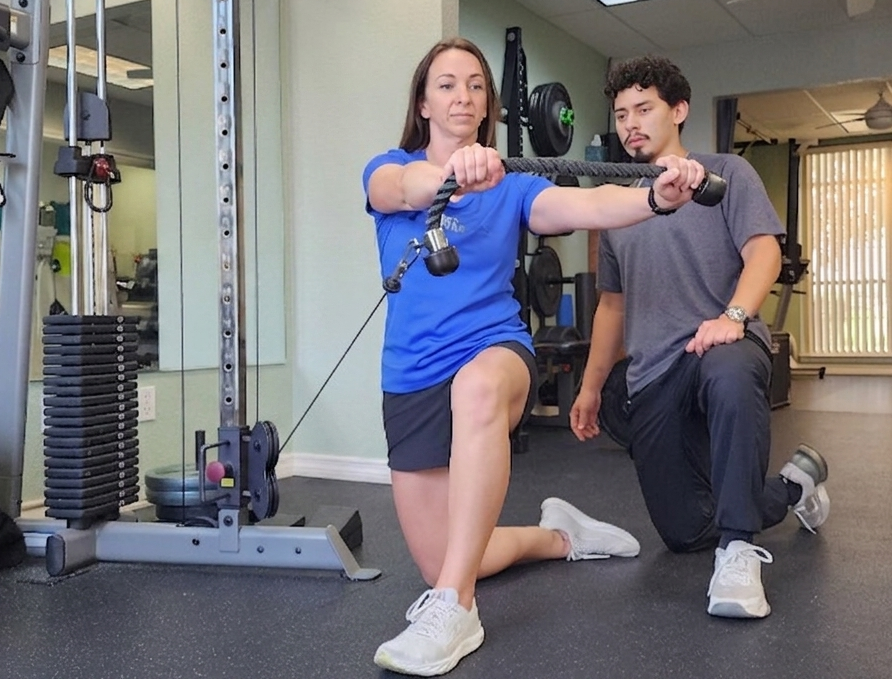
One of the questions we hear most often at Fitness Beyond Training is:
“What’s the difference between an Exercise Physiologist and a Personal Trainer?”
It’s a fair question. Both professions use exercise to help people become healthier, stronger, and more confident in their bodies. Both can play an important role in improving health, and both genuinely care about the people they serve.
Although we both became Exercise Physiologists, we arrived here through very different experiences. Looking back, our journeys taught us the same lesson:
Understanding how someone moves is often just as important as knowing how to make them stronger.
Isaac’s Perspective
A Football Injury Started My Journey
I didn’t always know I wanted to become an Exercise Physiologist. Like many athletes, I simply loved competing.
I still remember one football play that changed everything. I stood ready, waiting for the ball to snap. Suddenly, I was running with the ball tucked under my right arm. My legs carried me quickly through an opening. As I gained yards, someone hit me hard from the right and I fell. The coach blew the whistle. When I got up, a sharp pain shot through my left arm.
After a quick trip to the emergency room, I learned I had broken my humerus.
Thankfully, surgery wasn’t necessary. I was handed a general rotator cuff exercise list and told to do them while my arm healed. As time passed, I became fascinated by how my arm recovered. Why did some movements come back more easily than others? Why did certain exercises seem to help more than others?
That curiosity eventually led me to Tarleton State University, where I earned my degree in Kinesiology. Before graduating, I decided to become an Exercise Physiologist because I wanted to understand how the body moves and use that knowledge to help people achieve better movement.
Looking Beyond the Workout
After graduating, I worked as an Exercise Physiologist in a large commercial gym. One of the first things I noticed was that many of the clients I trained had never gone through any type of functional movement assessment before beginning an exercise program.

I realized I had an opportunity to approach things differently. Before writing their programs, I assessed joint mobility, movement patterns, and any pain or restrictions that appeared during the evaluation. Every client I worked with told me they had never been taken through that kind of process before.
The personal trainers I saw at the gym focused on training their clients on machines, and during peak hours their sessions could stall because the equipment they needed was not available. While those sessions stalled, the clients in front of me kept moving and getting stronger.
Rather than waiting for the next machine, we worked on compromised movement patterns through individualized programs centered on global corrective exercises, neuromuscular retraining, and functional strength.
The goal wasn’t simply to fill an hour with exercises. It was to improve how each client moved while continuing to build strength.
That experience showed me that clients didn’t always need another machine or a harder workout. Sometimes they needed someone to look at how they were moving and build the program from there.
Where I Believe an Exercise Physiologist Fits
When people ask me about the difference between an Exercise Physiologist and a Personal Trainer, I like to think of healthcare and fitness as a spectrum.
On one end are personal trainers helping people become stronger, lose weight, improve fitness, and develop healthier habits through exercise. On the other end are licensed rehabilitation professionals, such as physical therapists, who help people recover from surgery, acute injuries, and more complex medical conditions.
Exercise Physiologists often work between those worlds, not because we replace either profession, but because we combine movement assessment with strength and conditioning.
The difference is often how we get there.
Rather than immediately building an exercise program, we first look at how someone moves. If mobility restrictions, poor stability, movement compensations, or limited neuromuscular control are standing in the way of progress, we address those while continuing to build strength.
For some clients, that helps reduce injury risk. For others, it improves athletic performance, breaks through a frustrating plateau, or simply helps them keep doing the activities they enjoy.
Stronger. Healthier. More capable.
We simply believe the journey begins with understanding movement.
Mira’s Perspective
When Exercise Wasn’t Enough
Unlike Isaac, my journey didn’t begin with one moment of impact. It began with a love of exercise.
As a teenager, I wasn’t an athlete, but I loved the way exercise made me feel. Running, in particular, transformed my life. I went from being a chubby adolescent to a strong, disciplined young woman, and naturally I chose to pursue a degree in the subject I loved most. Exercise Physiology at the University of Utah felt like the obvious path.
Then, during my final year in the program, my own ability to exercise came to a startling halt. Unlike Isaac’s injury, mine wasn’t caused by one traumatic event. It developed slowly from sustained running on a faulty lumbopelvic-hip complex—although I had no idea that was the problem at the time. Sure, my knee ached from time to time, but wasn’t the saying, “No pain, no gain?”
The ache started showing up after shorter and shorter runs. Then it hurt between runs. Before long, it hurt all the time. I couldn’t run, I couldn’t lift, and eventually I couldn’t even use the elliptical without pain.
“Isn’t exercise supposed to make us stronger and healthier? How did this even happen?”
Like many people, I went to physical therapy hoping it would get me back to running. I made some progress, but not enough to run again or eliminate the knee pain. The next step was arthroscopic surgery. What stayed with me was how narrowly everyone focused on the knee. No one really stopped to look at what might have been happening elsewhere in my body to create the problem in the first place.
The surgery didn’t help. It just set me back from movement even longer.
With my degree in hand, I began my career as an Exercise Physiologist. My education opened the door to opportunities in professional training studios across the country, where I worked alongside talented coaches and trainers. We helped people become stronger, fitter, and healthier through great programming, sound structure, and consistent training.
But regardless of the professionals I worked with or the quality of the program, I kept seeing the same issue. Clients would be making real progress when some pesky knee, hip, back, or shoulder pain would creep up on them. They were doing all the right things—training regularly, eating better, and objectively reaching their goals—only to face a setback that cost them months of recovery and the results they had worked so hard to earn.
It felt too similar to my own story.
Why do people who are doing everything right still end up getting hurt?
That question changed the direction of my career. I stopped looking only at exercise selection and started looking more closely at movement itself. I immersed myself in Functional Movement Systems, the Selective Functional Movement Assessment, Dynamic Neuromuscular Stabilization, and years of continuing education focused on how the body moves as an integrated system.
The more I learned, the more I understood that the painful area is not always the whole story. A knee can be the place someone feels the problem without being the only place that contributed to it. The same can be true for a shoulder, hip, or lower back.
As I learned to address those underlying movement patterns through neuromuscular retraining, my own knee pain finally resolved. It reinforced something I had begun to suspect: the answer wasn't simply finding better exercises. It was understanding why the body had adapted the way it did in the first place.

My clients began reaching their goals with real, long-term success. They still became stronger. They still improved their fitness and performance. But now we were building those results on a better understanding of how their bodies moved, making them far less likely to lose months of progress to another avoidable setback.
That philosophy eventually became the foundation of Fitness Beyond Training.
Where Our Journeys Meet
Although our journeys began differently, they led us to the same conclusion.
We both believe strength and conditioning changes lives.
But we've learned that the best programs don't begin with choosing exercises.
They begin with understanding the person performing them.
That's why assessing and improving movement became the foundation of Fitness Beyond Training. Not because movement is the goal—but because it helps people become stronger, healthier, and more resilient for the long term.
Our Philosophy
There are exceptional professionals throughout the fitness industry, and a title alone doesn't determine the quality of someone's coaching. What matters is having the knowledge and experience to build strength on quality movement.
The difference isn't who cares more. It's often where the process begins.
Many exercise programs begin by asking:
“What exercises should this person do?”
Our process begins by asking:
“Why does this person move this way?”
That question can change everything that follows.
Looking back, our paths into this profession couldn't have been more different.
One began with a football injury.
The other with someone who loved exercise but could no longer do it without pain.
Different stories.
The same lesson.
At Fitness Beyond Training, we believe lasting strength is built on better movement—because the goal isn't simply to exercise more. It's to keep doing what you love for years to come.


Comments