Why Strength Training Alone Doesn’t Correct Movement

By Isaac Salas
Exercise Physiologist, Health & Fitness Professional, B.S. Kinesiology, ACSM EP-C
Getting stronger is good for you. But getting stronger doesn’t automatically mean you’re moving better.
When the body develops a compensation pattern, it finds a way to complete a movement using the muscles and joints that are most available to do the work. You may not notice it, especially if the movement still feels normal. You may even continue getting stronger without ever addressing the compensation. In other words, you can get stronger while still practicing a poor movement pattern.

Think about a deadlift.
Someone sets up at the bar, but as they begin to pull, they consistently shift into their right hip and rotate slightly to one side. It may be subtle. The bar still comes off the floor and they complete the lift, so from their perspective everything seems fine. They train consistently, their deadlift gets stronger, and eventually they're pulling significantly more weight. Most strength enthusiasts would call that progressive overload, and they’d be right. Progressive overload is an important part of getting stronger.
The problem is that the person may also be getting better at that shift. Every deadlift gives the body another opportunity to practice the same pattern. Adding more weight doesn't automatically cause the body to start distributing the load differently. In many cases, the body will rely even more on the movement strategy it already knows. And this can go on for a long time without pain.
The body is incredibly good at finding ways to keep us moving. If one area isn't moving well or doing its share of the work, another area can take over. Maybe one hip isn't moving as well as the other, or one side isn't producing force as effectively. The body finds a way to get the bar off the floor anyway.
Sometimes these compensations work for years before a person knows they're there.
That's why we often hear someone say, “I don't know what I did. My back just started hurting,” or, “I've been deadlifting for years and it's never bothered me before.”
The day something starts hurting isn't necessarily the day the problem started.
A person may have been moving with the same compensation for months or years. Meanwhile, they continue working, sitting, exercising, running, lifting and doing everything else life requires. At some point, the demands placed on the body may become more than that particular strategy can comfortably handle. Pain may be the first thing that finally gets their attention.
This doesn't mean every compensation will cause pain, and it doesn't mean all pain can be traced back to a movement dysfunction. Pain is more complicated than that. But being pain-free doesn't necessarily tell us that someone is moving well either.
That's one reason we want to identify movement problems before they become painful. If we can see that the body is repeatedly relying on the same compensation, we have an opportunity to address it rather than waiting until the person has a reason to stop.
Strength and Movement Are Not the Same Thing
Adding weight, increasing repetitions, or doing harder exercises isn't necessarily the answer to a movement problem. Strength gives the body more capacity, but we still need to be able to control and use that capacity.
This helps explain why someone can be very strong in the gym but struggle with certain everyday or athletic movements. When a task becomes faster, heavier, more complex, or less predictable, the body usually relies on the movement strategies it knows best.
Think about the weekend warrior who doesn't move much during the week and then goes hard on Saturday or Sunday. The same thing can happen with someone who trains hard every morning and is always chasing the next PR. There is nothing wrong with wanting to work hard or get stronger. We just need to make sure the body is prepared for what we're asking it to do.
The Missing Piece: Neuromuscular Retraining
The good news is that movement patterns can change. Addressing a compensation often requires more than strengthening a weak muscle. We also have to teach the nervous system and muscles to work together differently. This is what we mean when we talk about neuromuscular retraining.
That can include:
Improving body awareness and proprioception
Developing better muscle activation and coordination
Slowing movements down enough to recognize and change compensations
Improving mobility when a restriction is affecting the movement
Building control through a usable range of motion
Progressing from simpler exercises into more functional movements
Gradually adding speed, resistance, and load while maintaining the improved movement
Go back to the deadlift. Instead of simply telling that person to keep pulling heavier, we first want to know why they're shifting. Is one hip moving differently from the other? Are they able to create and maintain tension equally on both sides? Is one foot taking more pressure? Can they control each leg independently? Does the shift happen with an empty bar, or does it only appear as the load gets heavier?
Those questions matter because what we see during a movement isn't always where the problem starts. Once we have a better idea of what is contributing to the compensation, we can work on it and then gradually challenge the improved movement.
This doesn't mean spending the rest of your life doing corrective exercises with a resistance band. At some point, the improved movement needs to make its way back into the things you actually want to do, whether that's deadlifting, running, hiking, playing a sport or keeping up with your kids.
Better Movement Doesn't Mean Less Strength
Sometimes people hear “corrective exercise” or “movement retraining” and assume we're telling them to stop lifting or back away from hard training. That's not the point.
If you've already spent years getting stronger, we want to keep that strength. We just want your body to be able to use it as well as possible.
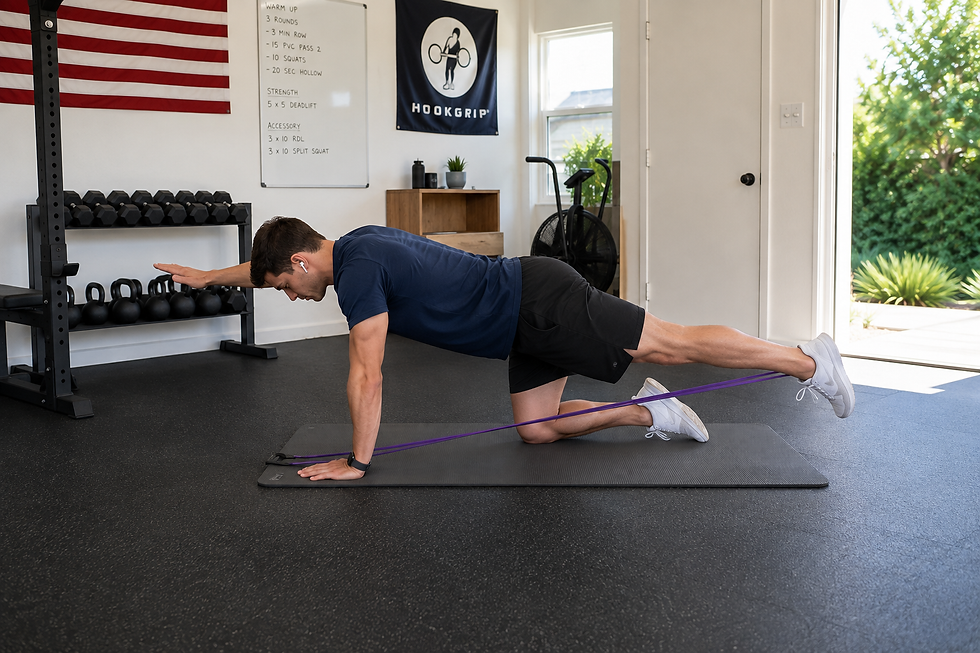
The same applies to someone who is just starting out. Strength and good movement don't need to be developed separately. We can work on both. We're also not looking for some perfect way of moving. Bodies are different, and movement will look different from one person to another. What we're looking for are compensations that may be limiting what someone can do and whether we can give the body a better way to handle the task.
Build Better Movement, Then Load It
Strength training still matters. A lot. We just shouldn't expect strength alone to solve every movement problem. If your body is compensating, adding resistance may make you stronger without changing the compensation. First we need to understand what's contributing to the movement, work on the areas that need it, and then bring load back into the picture.

That's a big part of what we mean by Fitness Beyond Training.
We don't believe you should have to choose between moving well and getting fit. We want to develop both. For one person, that may mean getting stronger. For another, it may mean improving cardiovascular fitness. An athlete may need better movement and control to develop a particular skill. Most people need some combination of all three.
The point isn't to spend all your time fixing movement. It's to build a body that moves well enough to handle the things you want to ask of it, and then build the fitness to do those things at a higher level.
Don’t just train around the way your body moves. Find out why it moves that way, and let's train better together.


Comments